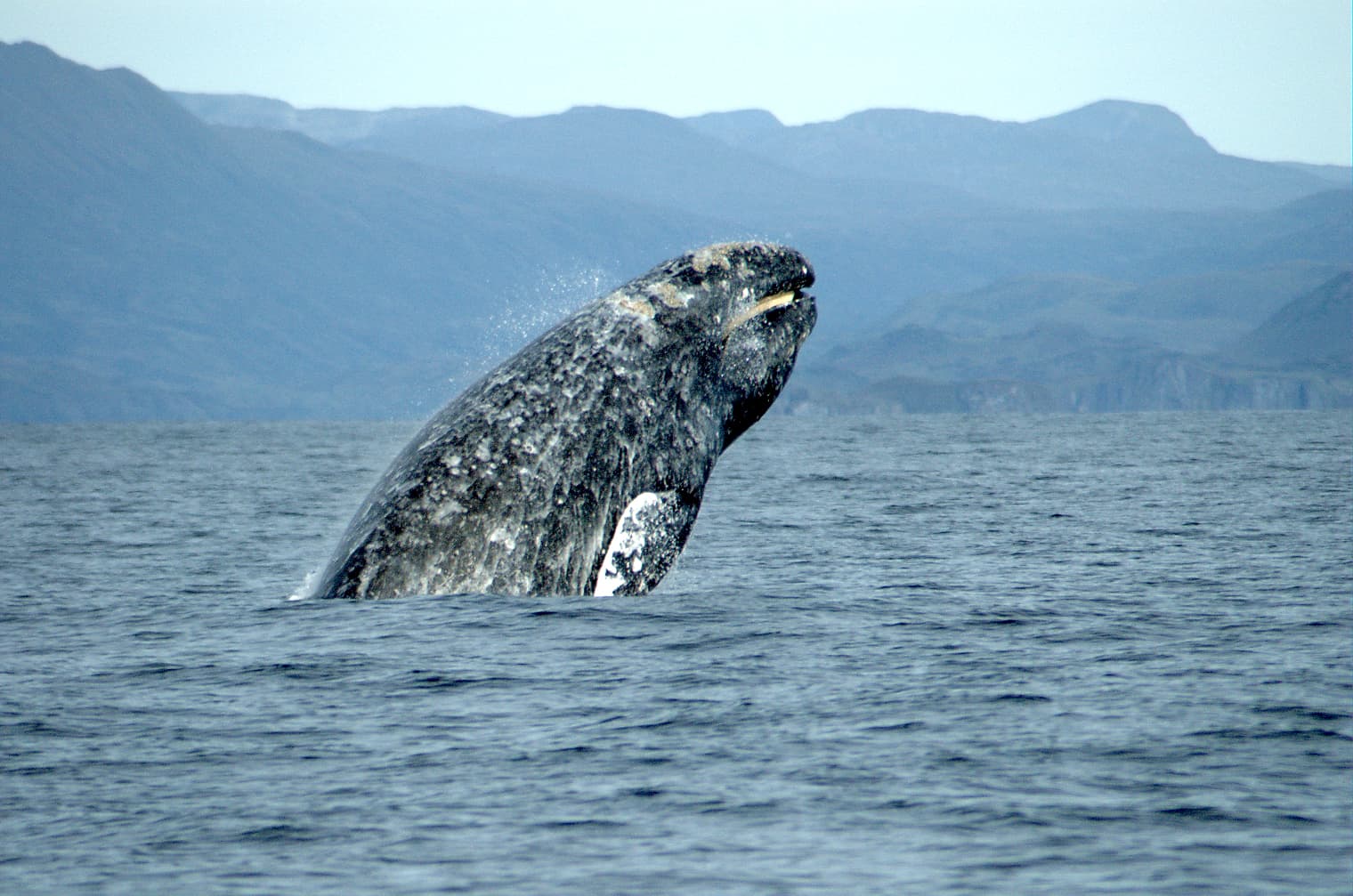
California Gray Whale
Eschrichtius robustus
A Giant of the Pacific
The California gray whale is a majestic baleen whale that has captivated coastal communities for generations. Adults typically reach 45 to 49 feet in length and weigh between 30 and 40 tons. Unlike the sleek, dark bodies of humpback or blue whales, gray whales have a distinctive mottled gray appearance covered in patches of white barnacles and orange whale lice. They lack a dorsal fin, instead sporting a series of small bumps called "knuckles" along the ridge of their lower back. Their broad, heart-shaped blow (the spray of exhaled air and water) is visible from shore on calm days and is often the first sign that a gray whale is passing by.
The Great Migration
Every year, gray whales undertake one of the longest migrations of any mammal on Earth. Beginning in October, they leave their rich feeding grounds in the Bering and Chukchi Seas of the Arctic and head south along the Pacific Coast. Their destination: the warm, shallow lagoons of Baja California, Mexico, where females give birth to calves in the protected waters. The total round-trip journey can cover 10,000 to 12,000 miles. Pregnant females lead the southbound migration, followed by other adults and juveniles. The northbound return begins in February, with mothers and newborn calves bringing up the rear in March and April, staying close to shore to avoid predators like orcas.
Bottom Feeders of the Sea
Gray whales have a unique feeding strategy among baleen whales. Rather than gulping huge mouthfuls of water and krill near the surface, gray whales are bottom feeders. They roll onto their sides on the ocean floor and scoop up sediment, then use their short, coarse baleen plates to filter out tiny amphipods, worms, and other invertebrates. This feeding style leaves distinctive "feeding pits" on the seafloor that other marine creatures then colonize, making gray whales important ecosystem engineers. Most gray whales feed primarily on their right side, which causes the baleen on that side to wear down more quickly. Scientists can actually tell a gray whale's preferred feeding side by examining its baleen.
Southern California's Favorite Whale
For Southern Californians, gray whale season is a beloved annual tradition. From December through April, these gentle giants pass so close to shore that they can often be spotted from coastal bluffs without binoculars. Cabrillo National Monument at Point Loma in San Diego is one of the premier land-based whale watching spots in the world, with park rangers stationed at overlooks to help visitors spot blows and breaches. Dana Point in Orange County has earned the nickname "Whale Capital of the West" for its exceptional whale watching. Local whale watch boats from ports in San Diego, Dana Point, Long Beach, and Ventura bring thousands of visitors within respectful viewing distance of these magnificent travelers each year.
A Conservation Success Story
The California gray whale is one of the greatest conservation success stories in marine biology. By the mid-1800s, commercial whaling had driven the population to near extinction. As few as a couple thousand animals remained. After international protections were established in 1946 and strengthened through the Marine Mammal Protection Act of 1972 and the Endangered Species Act, the eastern North Pacific population rebounded to an estimated 27,000 individuals. In 1994, the gray whale was removed from the Endangered Species List, making it one of the first marine mammals to be "delisted." However, recent years have seen an Unusual Mortality Event with elevated strandings, possibly linked to changes in Arctic prey availability driven by climate change. This reminds us that even recovered species need ongoing monitoring and protection.