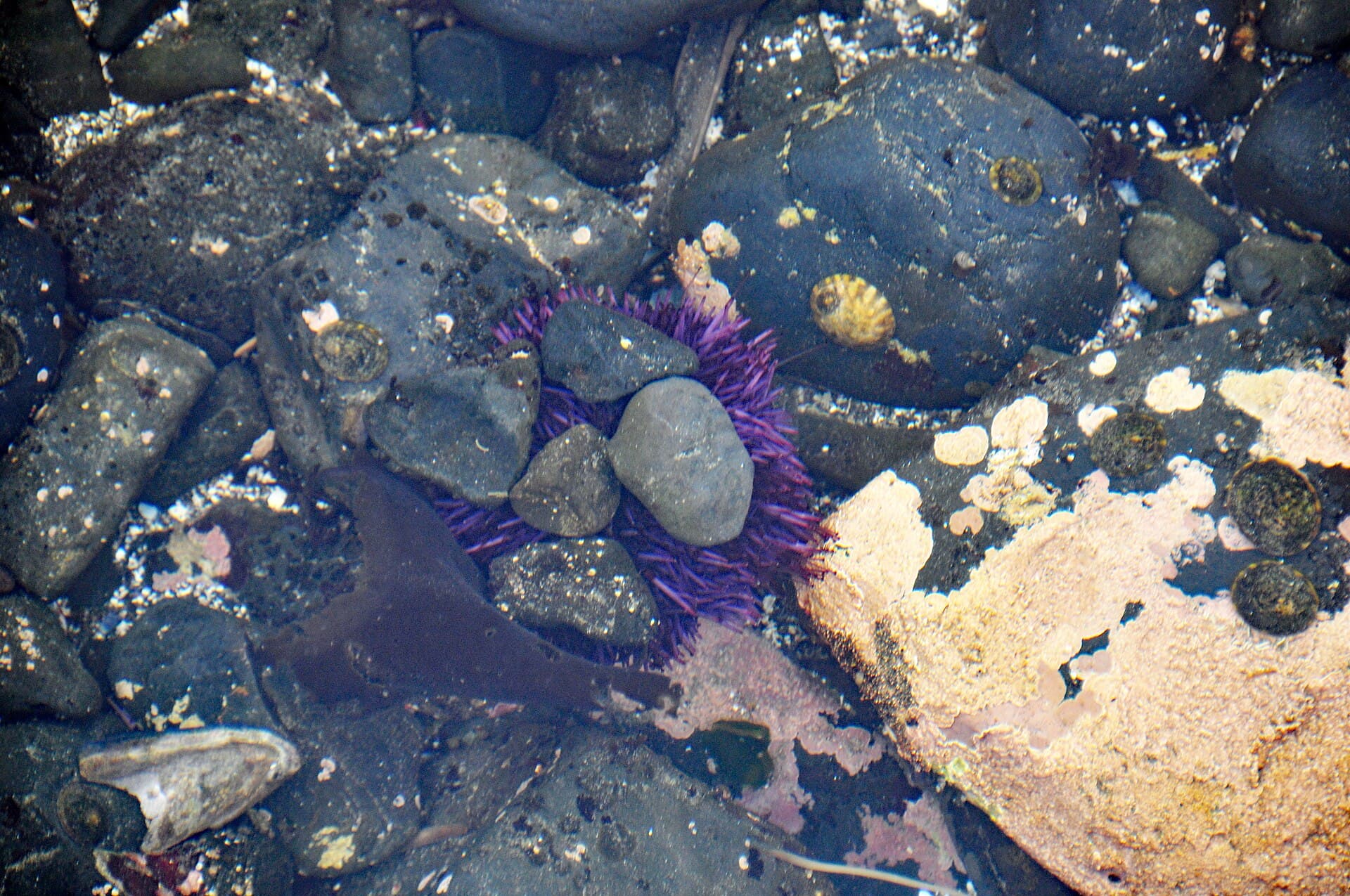
Purple Sea Urchin
Strongylocentrotus purpuratus
The Spiny Jewel of the Tide Pool
The purple sea urchin is one of the most common and recognizable inhabitants of Southern California's tide pools and rocky reefs. These small, round invertebrates are covered in dense arrays of sharp, movable spines that radiate outward from their spherical body like a living pincushion. Adults are typically 2 to 4 inches in diameter, with spines that add another inch or two. Their color ranges from deep royal purple to lavender, with the spines sometimes tipped in lighter shades. Beneath the spines, the urchin's hard outer shell, called a test, is divided into ten symmetrical sections arranged in a five-fold pattern. On the underside, five self-sharpening teeth arranged in a structure called Aristotle's lantern allow the urchin to scrape algae from rock surfaces and even bore into solid stone to create protective burrows.
A Surprisingly Complex Life
Despite their simple appearance, purple sea urchins have remarkably complex lives. They begin as microscopic larvae drifting in the ocean plankton, transparent and barely visible to the naked eye. After several weeks of planktonic life, the larvae settle onto hard substrate and undergo a dramatic metamorphosis, transforming into tiny urchins just a few millimeters across. From there, growth is slow but steady. Urchins move using hundreds of tiny tube feet that extend through pores in their test, hydraulically powered by an internal water vascular system. These tube feet, combined with their spines, allow urchins to navigate rocky terrain, grip surfaces in pounding surf, and even pass food toward their mouth. Purple sea urchins are primarily herbivores, grazing on algae and drift kelp, but they will also consume dead animal matter when available.
Ecosystem Engineers: For Better and Worse
Purple sea urchins play a dual role in marine ecosystems that makes them one of the most ecologically significant species in the Pacific. In a healthy, balanced kelp forest, moderate urchin populations perform a valuable service by grazing on algae that might otherwise overgrow and smother the reef. Urchins also help recycle nutrients and serve as an important food source for predators including sea otters, sheephead fish, sunflower sea stars, and spiny lobsters. However, when predator populations decline, urchin numbers can explode beyond the ecosystem's capacity. Millions of hungry urchins swarm across the reef, devouring everything in their path, including the holdfasts that anchor giant kelp to the seafloor. The result is an "urchin barren," a vast, lifeless expanse of bare rock where a diverse kelp forest once stood.
The Urchin Barren Crisis
The story of the purple sea urchin in recent years is a cautionary tale about what happens when ecosystems lose their balance. Beginning in 2013, a mysterious illness called Sea Star Wasting Syndrome swept through Pacific Coast sea star populations, causing their bodies to literally disintegrate. The sunflower sea star, a major predator of purple urchins, was nearly wiped out. Without this key predator, purple urchin populations along the California coast exploded by as much as 10,000 percent in some areas. Vast kelp forests from Northern California through Southern California were consumed, leaving behind barren rock populated by millions of starving urchins too emaciated to be commercially harvested. In Southern California, organizations like The Bay Foundation have pioneered restoration efforts, sending divers to manually remove urchins from targeted areas so kelp can regrow. The results have been promising. Cleared areas often see kelp return within months.
Tide Pool Treasures
For young ocean explorers visiting Southern California's tide pools, the purple sea urchin is often one of the first marine animals they encounter. Their vivid purple color, fascinating spiny texture, and the challenge of spotting them wedged into crevices and rock burrows make them a favorite among tidepoolers of all ages. Some of the best spots to observe purple urchins include the tide pools at Cabrillo Marine Aquarium in San Pedro, Crystal Cove State Park in Newport Coast, and Abalone Cove in Rancho Palos Verdes. When visiting, remember that these animals are alive and sensitive to disturbance. Never pick them up, and be careful where you place your feet. The purple sea urchin's story teaches us a powerful lesson about the interconnectedness of ocean life: even a small, spiny creature can reshape an entire ecosystem when the natural checks and balances are disrupted.