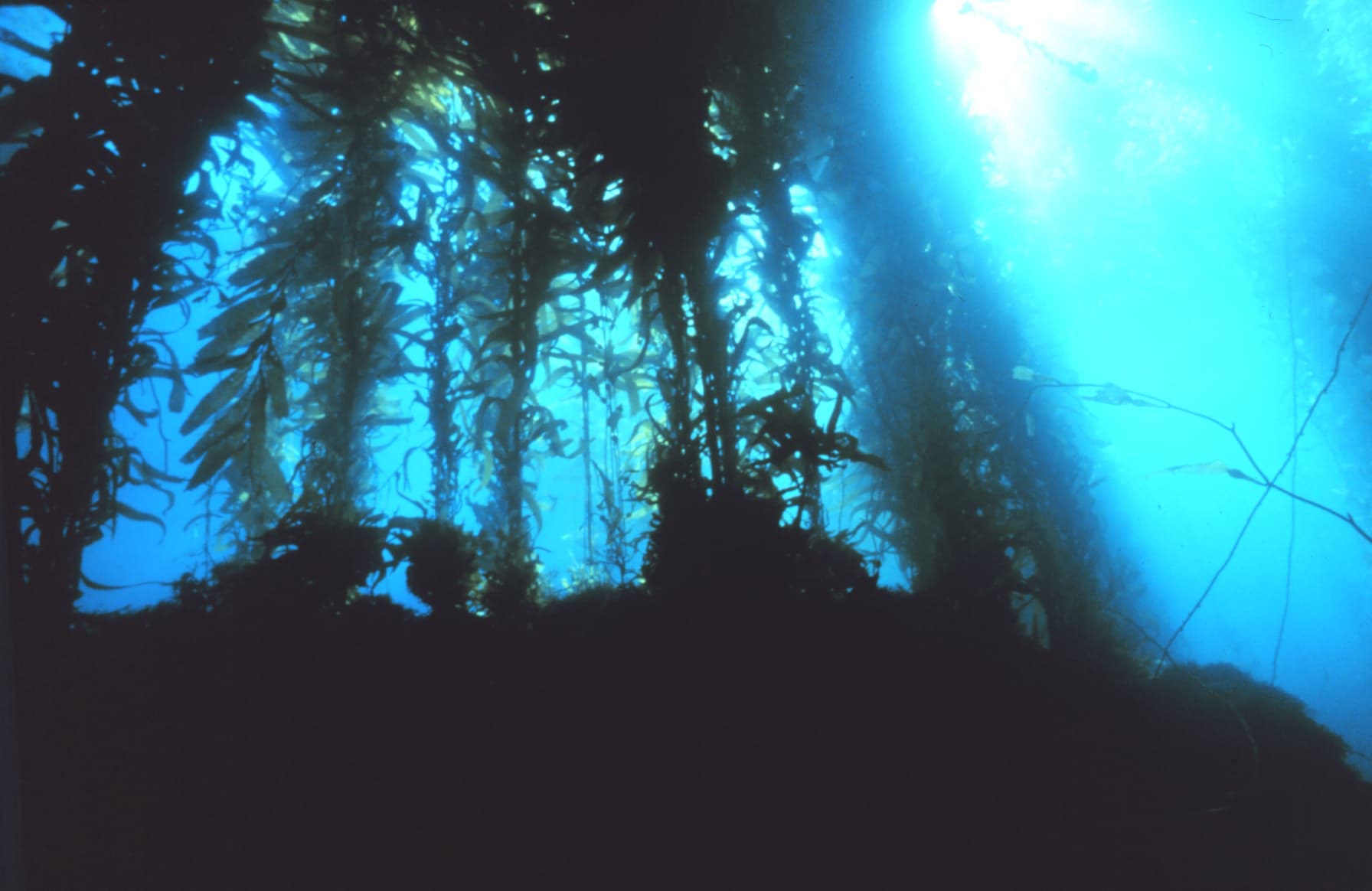
Giant Kelp
Macrocystis pyrifera
The Underwater Forest
Giant kelp is not just seaweed. It is the foundation of one of the most spectacular and productive ecosystems on Earth. Rising from rocky seafloors in cool, nutrient-rich waters, giant kelp forms towering underwater forests that rival terrestrial rainforests in their biodiversity and ecological importance. A single giant kelp individual, called a thallus, can grow to over 150 feet in length, stretching from the ocean floor all the way to the surface where its fronds spread out in a golden-brown canopy. Despite its tree-like appearance, giant kelp is not a plant at all. It is a brown alga, a type of protist that uses photosynthesis to convert sunlight into energy. Its "roots" are actually a structure called a holdfast that anchors it to rock, and its "leaves" are flat blades, each buoyed by a small gas-filled float called a pneumatocyst.
Growing at Warp Speed
Giant kelp holds the title of the fastest-growing organism on Earth. Under ideal conditions (cool water temperatures between 50 and 65 degrees Fahrenheit, clear water that lets sunlight penetrate, and plenty of dissolved nutrients), giant kelp can grow up to 2 feet per day. This explosive growth rate means a kelp forest can recover from storm damage or grazing remarkably quickly, provided conditions are favorable. The kelp's life cycle begins when microscopic spores settle on hard substrate and grow into tiny male and female gametophytes. After fertilization, a new sporophyte begins to grow, producing fronds that race toward the sunlight. A single kelp plant may produce dozens of fronds, each one a long, ribbon-like blade with its own pneumatocyst float. The entire organism typically lives for about 4 to 7 years.
A City Beneath the Waves
The ecological importance of giant kelp cannot be overstated. Kelp forests support more than 800 species of marine animals, providing food, shelter, nursery habitat, and hunting grounds for an astonishing diversity of life. Within the kelp canopy at the surface, sea otters wrap themselves in fronds to sleep without drifting away. In the midwater, schools of garibaldi, sheephead, kelp bass, and senoritas weave among the stipes. On the forest floor, lobsters, sea cucumbers, abalone, and sea stars forage among the holdfasts. Seals, sea lions, and even gray whales use kelp forests as shelter from rough seas and open-ocean predators. Kelp forests also provide critical "ecosystem services" to humans: they buffer coastlines from wave erosion, absorb carbon dioxide, produce oxygen, and filter nutrients from the water.
Kelp Forests of Southern California
Southern California is home to some of the most iconic kelp forests in the world. The extensive beds off Point Loma in San Diego, the Palos Verdes Peninsula, and the Channel Islands have been studied by marine scientists for over a century, making them among the best-understood kelp ecosystems globally. These forests are accessible to the public through kayaking at Point Loma, glass-bottom boat tours at Catalina Island, and snorkeling at Crystal Cove State Park and Leo Carrillo State Park. The Kelp Forest exhibit at the Birch Aquarium at Scripps in La Jolla gives visitors a window into this underwater world without getting wet. For young ocean explorers, few experiences compare to snorkeling through a kelp forest for the first time. Floating above the swaying canopy as sunlight filters through the fronds is like visiting another planet.
A Forest Under Threat
Despite its remarkable growth rate and resilience, giant kelp faces serious and growing threats. Warming ocean temperatures associated with climate change are pushing water conditions beyond kelp's comfort zone in many areas. When water temperatures rise, kelp growth slows and the algae become stressed. At the same time, warmer waters favor the reproduction of purple sea urchins, which are voracious kelp grazers. In healthy ecosystems, urchin populations are controlled by predators like sea otters, sheephead fish, and sunflower sea stars. But the catastrophic die-off of sunflower sea stars due to Sea Star Wasting Syndrome beginning in 2013 removed a key urchin predator, allowing purple urchin populations to explode. Vast stretches of once-lush kelp forest have been converted to "urchin barrens," underwater deserts of bare rock. Organizations like The Bay Foundation in Santa Monica are leading kelp restoration efforts, removing excess urchins by hand to allow kelp to regrow. This painstaking work offers hope, but addressing the root causes of ocean warming remains essential.